
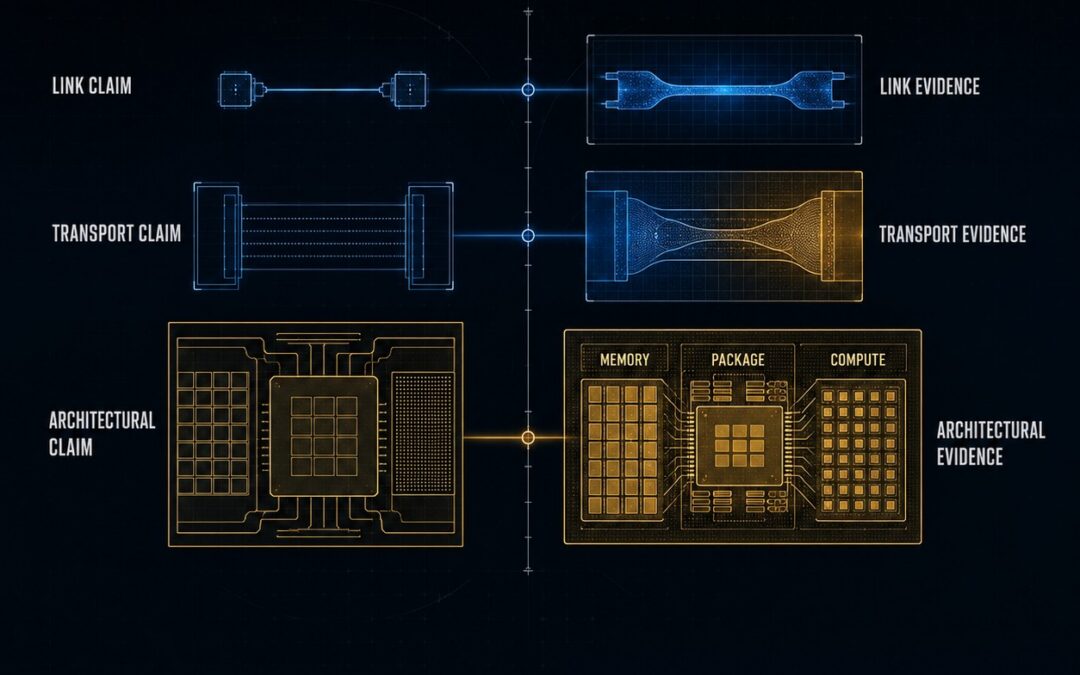
Performance Is Essential—but What Does It Establish?
High-speed transport is built on measurement.
Bandwidth matters.
Loss matters.
Signal integrity matters.
Power matters.
Reach matters.
Each helps establish whether a physical path can perform its intended function.
But the meaning of a result depends on the claim being made from it.
A measurement may establish that one implementation performs better than another. It may show that a path preserves signal quality over a particular operating range or under a defined set of conditions.
Those are important technical findings.
They do not automatically establish that the surrounding architecture can change.
That requires evidence at another level.
A Better Link May Leave Every Major Decision Unchanged
Suppose a transport path demonstrates improved performance.
The result may create more operating margin. It may support higher bandwidth, greater reach or reduced burden elsewhere in the link.
Yet the system may still require:
- the same relationship between memory and compute
- the same package boundaries
- the same beachfront allocation
- the same equalization or regeneration
- the same conversion point
- the same power and thermal provisions
In that case, the link has improved—but the architectural design space has not materially changed.
This is not a criticism of incremental progress. Many valuable engineering advances improve performance, reliability, manufacturability or cost without reorganizing the system around them.
The distinction matters only when the claim extends beyond the link.
If the proposition is that transport can affect architecture, then the evidence must eventually show an architectural consequence.
Three Levels of Evidence
A disciplined evaluation should distinguish among three related questions.
1. What physical behavior was observed?
The first level concerns the path itself.
Was the relevant behavior measured or simulated under meaningful conditions?
Is it repeatable?
Does it remain stable across the operating region being considered?
This level establishes what happened physically.
It does not yet establish what the result means for the larger system.
2. Which transport constraint changed?
The second level connects physical behavior to a design limitation.
Did the result alter a meaningful constraint involving reach, density, signal preservation, power, area, thermal burden or the need for supporting circuitry?
This is where a performance result begins acquiring architectural relevance.
But the analysis cannot stop there.
A constraint may improve without moving far enough to affect a system decision.
3. What can the architecture now do differently?
The third level is the architectural test.
Can memory and compute be placed differently?
Can a package boundary move?
Can beachfront resources be allocated differently?
Can equalization, regeneration or conversion be reconsidered?
Can the system recover meaningful power, area, thermal capacity or design freedom?
The specific answer will differ by architecture.
The underlying principle does not:
Architectural evidence exists when a demonstrated change in physical behavior permits a materially different system decision.
The Evidence Chain Must Remain Intact
An architectural conclusion requires a traceable relationship:
Observed physical behavior
→ Changed transport constraint
→ Newly available system decision
If the first link is missing, the proposition lacks physical evidence.
If the second is missing, the measurement has not been connected to the transport limitation it is intended to address.
If the third is missing, the architectural consequence remains hypothetical.
This does not mean every experiment must reproduce an entire computing system.
It means the evidence plan should be constructed backward from the decision the architecture may need to make.
What decision is currently constrained?
Which transport condition constrains it?
What physical behavior would have to change?
What evidence would establish that the change is real, repeatable and consequential?
Those questions produce a different validation strategy than beginning with the most impressive available metric.
Why This Matters as AI and HPC Systems Scale
AI and high-performance computing systems are becoming increasingly interdependent.
Memory, compute, packaging, power delivery, thermal management and physical data movement can no longer be optimized as though each exists independently.
A transport result that appears modest in isolation may matter greatly if it moves a critical system boundary.
A result that appears extraordinary at the link level may matter less architecturally if the surrounding system must still make all the same compromises.
The purpose of architectural evidence is therefore not to replace conventional link measurement.
It is to connect that measurement to the larger decision.
The most consequential question is not simply:
How well does the path perform?
It is:
What does that performance permit the architecture to do differently?
And if the evidence shows that a transport constraint has genuinely moved, another question follows:
I just could not leave your web site before suggesting that I really enjoyed the standard information a person supply to your visitors Is gonna be again steadily in order to check up on new posts