
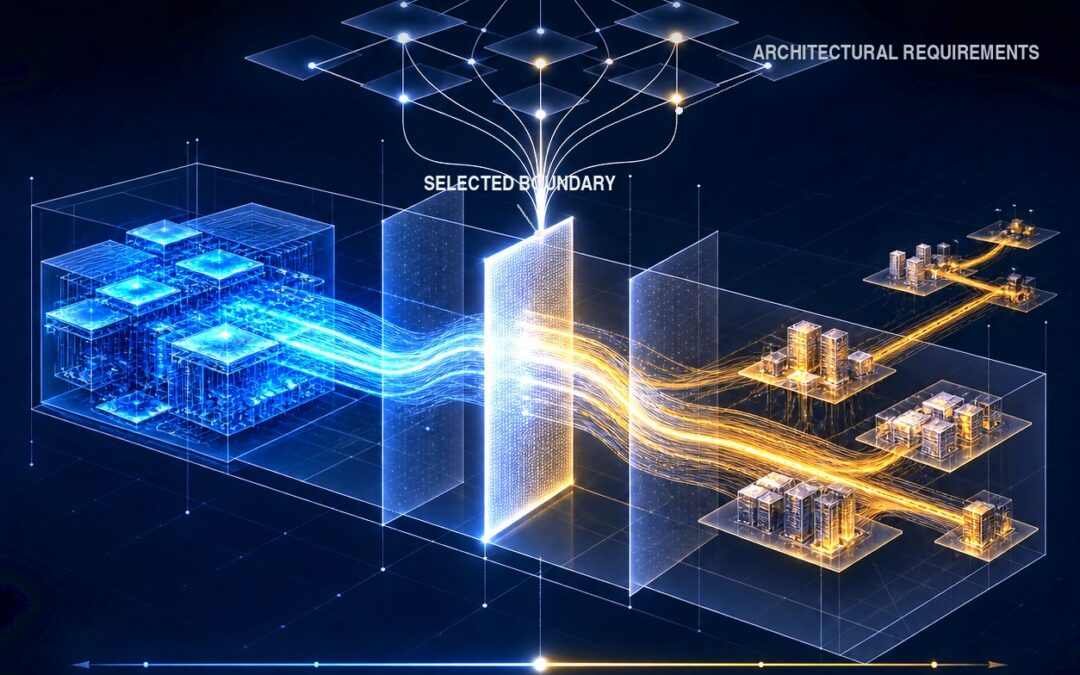
The Technology Debate Starts Too Late
High-speed transport discussions are frequently framed as a choice.
Electrical or optical?
Copper or fiber?
Keep the signal electrical—or convert it to light?
These comparisons are useful, but they can begin too far downstream in the design process.
They start with available technologies before fully defining the architectural problem those technologies must solve.
The first question should not be which transport technology appears most capable in isolation.
It should be:
What data must move, where must it move, and what physical conditions exist along the path?
That path may begin within a tightly integrated memory-and-compute environment.
It may continue across a package, board, module, chassis or rack.
The required bandwidth may remain high while the physical conditions surrounding its movement change substantially.
Distance changes.
Density changes.
The available area changes.
Power and thermal constraints change.
Packaging options change.
The value of direct integration may also change.
An end-to-end path is therefore not necessarily one transport problem.
It may be several different physical problems connected together.
One Path Can Contain Multiple Operating Domains
Electrical transport is governed by the interaction among conductors, dielectric materials, return-current paths and surrounding structures.
At highly integrated distances, it may provide a direct path between components without requiring the signal to change physical form.
But as bandwidth density, operating frequency or reach increases, the electrical path may require more architectural accommodation.
Loss must be managed.
Reflections and coupling must remain controlled.
Routing and return structures consume physical space.
Equalization and signal conditioning consume power.
Package and board geometry become increasingly consequential.
Optical transport encounters a different set of constraints.
Its system-level behavior depends on factors including electrical-to-optical conversion, coupling efficiency, source efficiency, modulation, alignment, packaging and thermal control.
Optical transport may change the relationship between bandwidth and distance, but it does not remove the need for electrical connectivity near memory and compute.
Nor does it make conversion free.
The two regimes therefore do not scale in identical ways.
More importantly, neither regime is universally superior across every portion of the path.
A physical approach that is well suited to one operating domain may be inefficient, difficult to integrate or unnecessarily complex in another.
The architectural opportunity is not necessarily to choose one regime for the entire system.
It may be to identify where the conditions change enough that the transport physics should change with them.
The Boundary Is an Architectural Decision
Once a path can contain more than one physical regime, the location of the handoff becomes consequential.
Move the boundary closer to compute, and optical conversion may gain access to more of the path.
But conversion, source, thermal and packaging requirements must also move closer to one of the system’s most constrained environments.
Move the boundary farther away, and the electrical path remains direct for longer.
But the system must then support electrical signal integrity across a greater physical span.
Neither placement is automatically correct.
The boundary affects:
- Component placement
- Package and board organization
- Power distribution
- Thermal strategy
- Routing density
- Signal conditioning
- Manufacturing complexity
- Test and validation
- Serviceability
- Overall system topology
The electrical–optical boundary is therefore not merely the location where one signal format becomes another.
It helps determine how the architecture on both sides must be organized.
The Handoff Is Not Free
A mixed-regime path can allow different transport physics to serve different portions of the system.
But every additional handoff introduces obligations.
The conversion must fit within an area budget.
It must operate within a power and thermal budget.
It must meet latency requirements.
It must preserve the required data integrity.
It must be manufacturable, alignable, testable and reliable.
Its benefits must persist after the complete implementation burden is included.
This creates an important architectural threshold:
The boundary is justified only when the benefit of changing physical regimes exceeds the system-level cost of making the transition.
That threshold cannot be determined from one isolated link metric.
A lower-loss optical span does not, by itself, prove that conversion belongs closer to compute.
A high-performing electrical link does not, by itself, prove that the electrical domain should extend farther.
The decision requires an end-to-end comparison of the architecture each option makes possible—and the resources each option consumes.
Begin With the Movement the System Requires
A more disciplined design sequence would begin by defining the movement of data before selecting how that movement will be implemented.
Ask:
What data must move?
Is the traffic continuous, burst-oriented, latency-sensitive or locality-dependent?
Where must it move?
Within a package? Across a board? Between modules? Across a larger system?
What must the path deliver?
Bandwidth, bandwidth density, latency, energy efficiency, reliability and physical reach are related—but they are not interchangeable.
What resources may the movement consume?
Area, power, thermal headroom, routing capacity, signal margin, packaging complexity and design freedom all belong to the architectural budget.
Where do the governing constraints change?
That is where another physical regime may become appropriate.
Only after those questions are answered should the architecture determine where electrical transport belongs, where optical transport belongs, and where the handoff between them should occur.
The Architecture Comes Before the Technology.™
This principle does not favor electrical transport.
It does not favor optical transport.
It favors understanding the system before selecting the technologies that will define it.
If the architecture begins with a preferred technology, the system may be forced to accommodate that technology’s natural limitations.
If the architecture begins with the required movement of data, each transport regime can be evaluated according to where its physics is most useful.
That changes the objective.
The goal is no longer to extend one technology as far as possible or introduce another as early as possible.
The goal is to place each physical regime where it creates the greatest architectural value—and the least unnecessary burden.
Where Should the Physics Change?
As AI and HPC systems continue to scale, the electrical–optical boundary may become increasingly fluid.
It may move among the package, board, module and larger system as bandwidth density, energy, reach, thermal conditions and integration capabilities evolve.
The most consequential innovation may therefore be more than a faster electrical link or a more integrated optical device.
It may be the ability to reconsider where the system changes physical regimes—and what architectural choices become available when that boundary moves.
But that leaves an important unresolved question.
If the best path uses more than one form of transport:
Just wish to say your article is as surprising The clearness in your post is just cool and i could assume youre an expert on this subject Fine with your permission allow me to grab your RSS feed to keep updated with forthcoming post Thanks a million and please keep up the enjoyable work