

AI water use is not just about power drawn in a lab. The real challenge appears when systems move into full deployment, where infrastructure choices shape water demand year over year. Your interconnect architecture plays a key role in managing thermal load and operational risk as scale grows. This post breaks down why a single water-use number falls short and what drives data center water consumption in production-ready AI systems. Read more about AI’s cooling problem and its impact on water use.
Understanding AI Water Use
AI systems aren’t just about processing power; they also bring complex resource demands, especially when scaled for production. Among these demands, water use becomes a significant consideration.
Factors Influencing Water Consumption
Several factors determine how much water is used. One key factor is the method of cooling data centers. Cooling is essential to prevent overheating. Factors like geographic location also affect water usage due to varying climates. Systems in hotter areas might need more water for cooling. Additionally, the design of your infrastructure, especially the interconnect architecture, can impact how effectively water is utilized.
Misleading Single Number Estimates
A single number for AI’s water use doesn’t paint a full picture. Water consumption varies widely based on the data center’s size, location, and cooling methods. For example, some centers use more water-efficient cooling technologies, while others rely more heavily on water. By focusing solely on an average, you might miss specific areas where improvements can be made.
Infrastructure Driving Water Demand
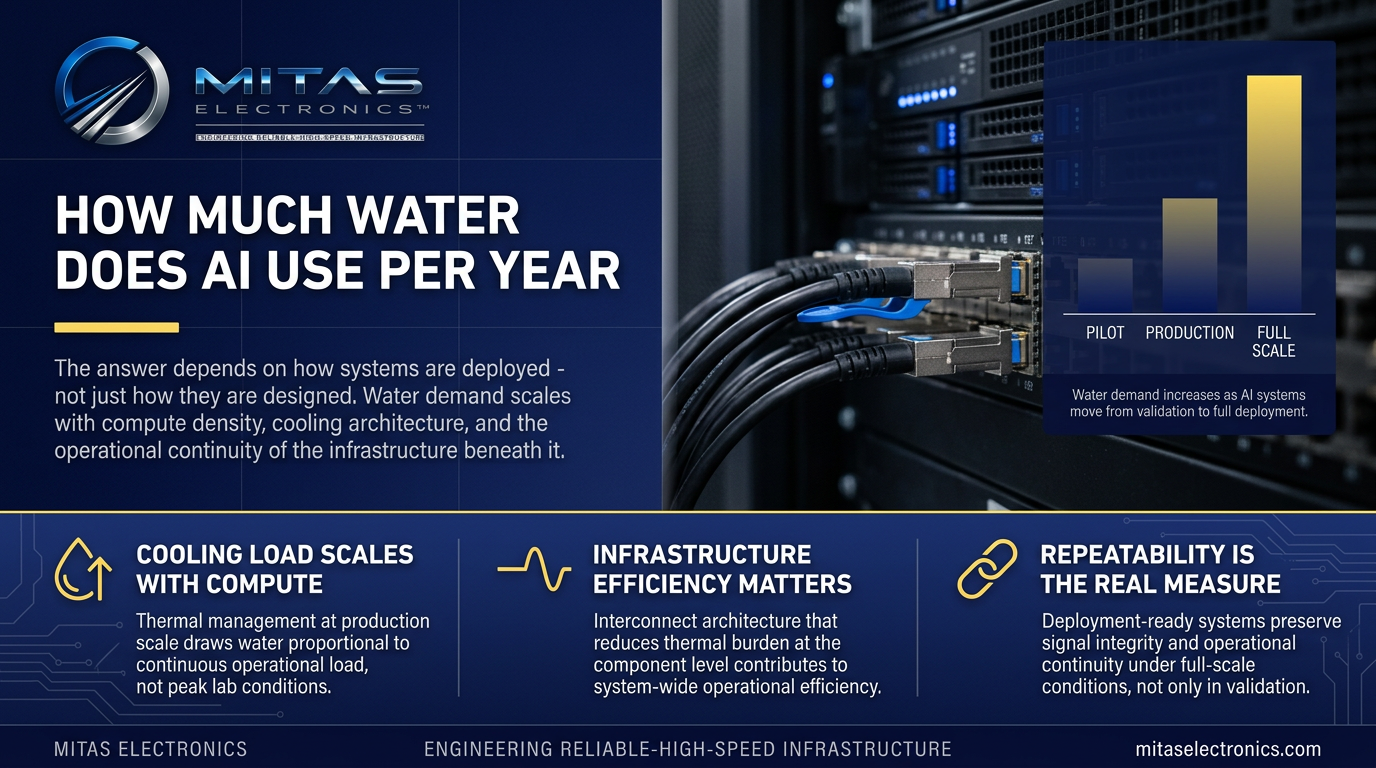
Infrastructure choices heavily influence the overall water demand of AI systems. It’s crucial to understand how each component contributes to this need.
Interconnect Architecture and Cooling
The interconnect architecture plays a pivotal role. This architecture affects how heat is managed and dissipated across the system. Efficient design can lead to reduced thermal loads and operational risks. When your interconnects are optimized, they help maintain signal integrity while also reducing the need for excessive cooling.
Liquid Cooling vs Air Cooling
Choosing between liquid and air cooling impacts water use. Liquid cooling is often more efficient, using water or other liquids to transfer heat directly. This method can reduce the need for large volumes of water over time. Conversely, air cooling might require more water for maintaining optimal temperatures, especially in larger data centers. Understanding these differences helps in making informed decisions for your infrastructure.
Scaling AI with Sustainability in Mind
Scaling AI systems responsibly requires addressing sustainability concerns head-on. This involves considering both environmental impacts and operational efficiency.
Prototype to Production Challenges
Transitioning from prototype to production reveals challenges. Prototype systems may not account for large-scale resource use. As you scale, you’ll need to rethink infrastructure to ensure sustainability. Efficient cooling systems and robust interconnects become more significant at this stage, impacting both water use and overall system efficiency.
Deployment Readiness and Efficiency
Achieving deployment readiness means ensuring systems operate efficiently at scale. This involves fine-tuning infrastructure to minimize water use while maintaining performance. Effective thermal management strategies, coupled with optimized interconnect designs, help reduce unnecessary water consumption. As you prepare for full-scale deployment, focusing on these elements supports both operational success and sustainability goals.
Frequently Asked Questions
What impacts AI water use the most?
Cooling systems have one of the most significant impacts on water use in AI systems. The choice between liquid and air cooling and the efficiency of interconnect architectures can greatly influence overall consumption.
How can data centers reduce water use?
Data centers can reduce water use by adopting more efficient cooling methods, such as liquid cooling, and optimizing infrastructure designs to lower thermal loads. Implementing these strategies helps to minimize the need for excessive water.
Why can’t a single number represent AI’s water use?
A single number doesn’t account for variations in data center sizes, locations, and cooling technologies. Each center has unique factors affecting water consumption, making a single estimate misleading.
What role does interconnect architecture play in water use?
Interconnect architecture affects how heat is managed in a system. Efficient designs can reduce thermal loads, leading to less cooling and water usage, thereby increasing overall system efficiency.
How do prototype and production stages differ in water use?
Prototypes often don’t consider large-scale resource demands. As systems move to production, infrastructure needs to be optimized for efficiency, impacting both water use and sustainability.