
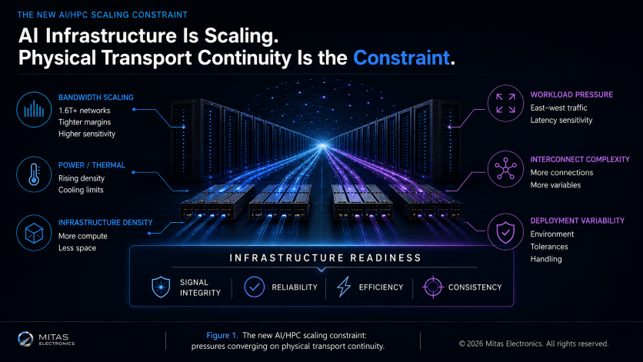
AI and high-performance computing infrastructure are entering a new scaling era.
Compute density is rising. Rack-scale systems are becoming more tightly integrated. Network bandwidth is increasing. AI workloads are placing greater pressure on east-west traffic, synchronization, latency, congestion, thermal behavior, and deployment consistency.
In this environment, the physical movement of data is no longer a secondary infrastructure detail. It is becoming a system-level constraint.
For years, much of the high-speed ecosystem has focused on faster components, faster links, denser optics, and higher aggregate bandwidth. Those advances remain essential. But as AI/HPC systems scale, the deeper question is not only whether individual components can pass validation.
The more strategic question is whether the physical transport layer can preserve signal integrity, reliability, efficiency, and continuity across the full infrastructure.
That is the emerging importance of physical transport continuity.
Physical transport continuity is the disciplined alignment of signal integrity, transport-layer behavior, system reliability, operating efficiency, manufacturing repeatability, supply continuity, and deployment support across the physical data movement path.
It is not a single component specification. It is a system-level readiness discipline.
For AI/HPC leaders, this shift changes the standard for infrastructure readiness. The goal is not simply to validate performance in controlled conditions. The goal is to sustain predictable system behavior as infrastructure becomes denser, faster, more synchronized, and more difficult to deploy.
|
STRATEGIC POSITION: Transport physics is becoming a strategic layer of AI/HPC infrastructure readiness. |
